
DeWitt County Court Records After Arrest
A DeWitt County jail arrest creates two related but separate records. The jail record is the custody record. It can confirm whether a person is held at the jail, what charges were entered at booking, and what bond amount is listed. The court record begins when the prosecutor or court filing process turns that arrest into a formal criminal case, such as a complaint, information, indictment, setting, plea, dismissal, or disposition.
The DeWitt County Sheriff's detention page says the jail does not schedule or maintain court dockets and does not have pending court-date information. That instruction is important. For custody and booking facts, use DeWitt County jail inmate records. For booking photos, use the DeWitt County jail mugshots record path. For court records after a jail arrest, use the clerk and prosecutor channels tied to the case level.
Search DeWitt County Court Records
County-level criminal index access starts with the DeWitt County Clerk's official page and its linked Local Government Solutions portal. The clerk page states that online access is offered for Official Public Records, Criminal, Civil, and Probate records, but it also warns that criminal, civil, and probate records show only the index online because case files may contain confidential information. The online database is not described as the complete official repository.
The Local Government Solutions online records portal is the clerk-linked search route for DeWitt County indexes.
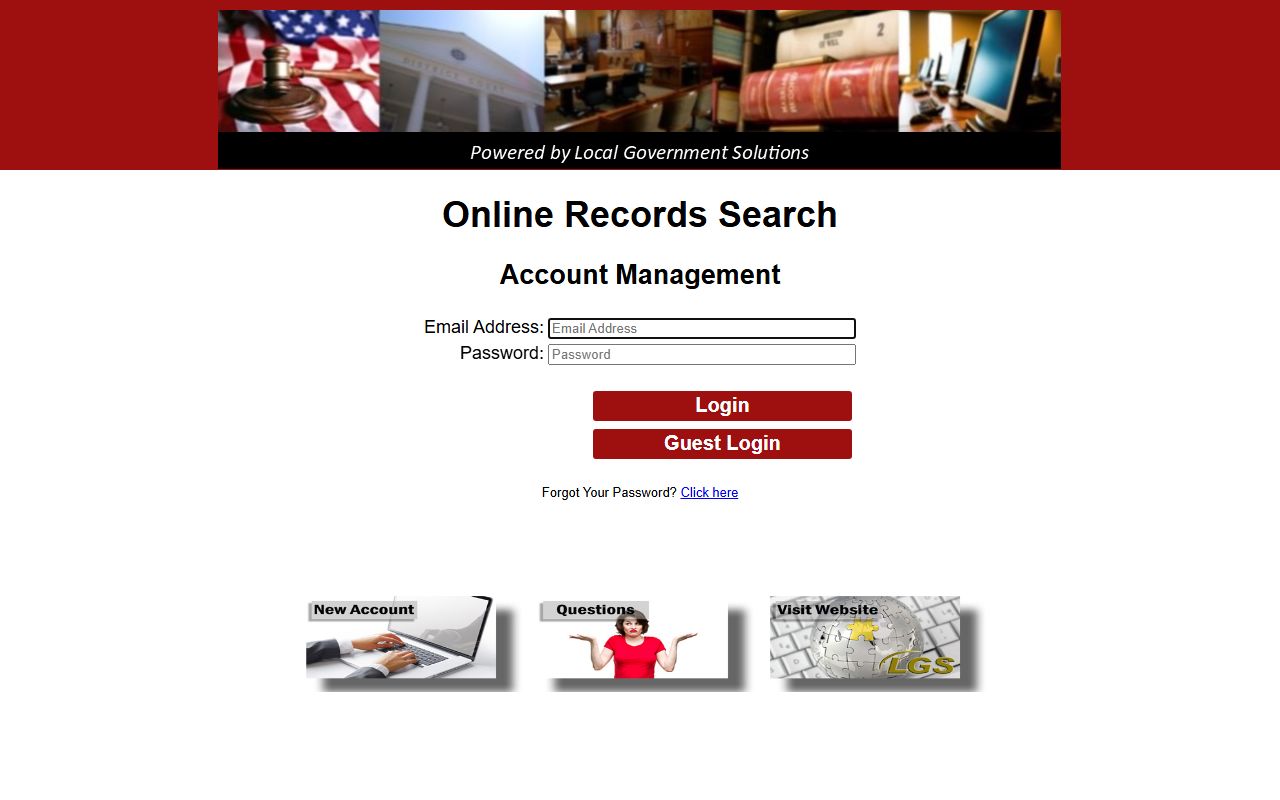
The portal image fits court-record searches because the county clerk points users there for online index access, while full case documents may still require the clerk's office.
- Use the jail roster only to confirm the arrest, booking charge, custody, and bond amount.
- Decide whether the formal case is likely a county-court matter or a district-court matter.
- Use the county clerk's LGS link for county criminal index searches.
- Contact the district clerk for felony or district-court records, especially where paperless filing affects newer records.
- Search by defendant name or case number when the portal or clerk offers those fields.
- Compare the jail charge with the court charge, because the prosecutor may file, amend, reduce, add, or dismiss counts.
DeWitt County Court Search Fields
The research captured only partial search fields for the LGS online records portal. That is still useful because it shows the online boundary set by the county clerk: criminal, civil, and probate material is index-only online due to confidential information in case files. A person needing the full court record after an arrest may need to contact the county clerk or district clerk after finding the index entry.
| Field Label | Type | Required | Options / Format Notes |
|---|---|---|---|
| Portal / county selection | web portal | unspecified | The DeWitt County Clerk links to LGS Online Records for OPR, criminal, civil, and probate records. |
| Criminal index | record category | optional | County says only the criminal index is available online due to confidential information in case files. |
| Civil / Probate index | record category | optional | Also index-only online for confidential-information reasons. |
| Official Public Records | record category | optional | OPR index and most OPR images are available online. |
DeWitt County Clerk Routes
The DeWitt County Clerk handles county clerk records and links the public to online record access. The clerk page also gives an open-records email route and explains that redactions may appear in certain instruments under state law. For misdemeanor or county-court criminal index questions, the county clerk is the starting point unless the case belongs in another court.
Felony and district-court records run through the DeWitt County District Clerk. The district clerk page lists District Clerk Esther Ruiz, the courthouse address, phone 361-275-0931, and the records email dewitt-county-district-clerk@dwcotx.org. It also says the office closes at 4:45 p.m. and that, effective January 1, 2026, district courts have gone paperless in the District Clerk's Office. E-filed documents are treated as originals and filings brought to court are scanned into Enterprise Justice.
The district clerk page shown below is the official DeWitt County source for district records contact details and paperless-court notices.
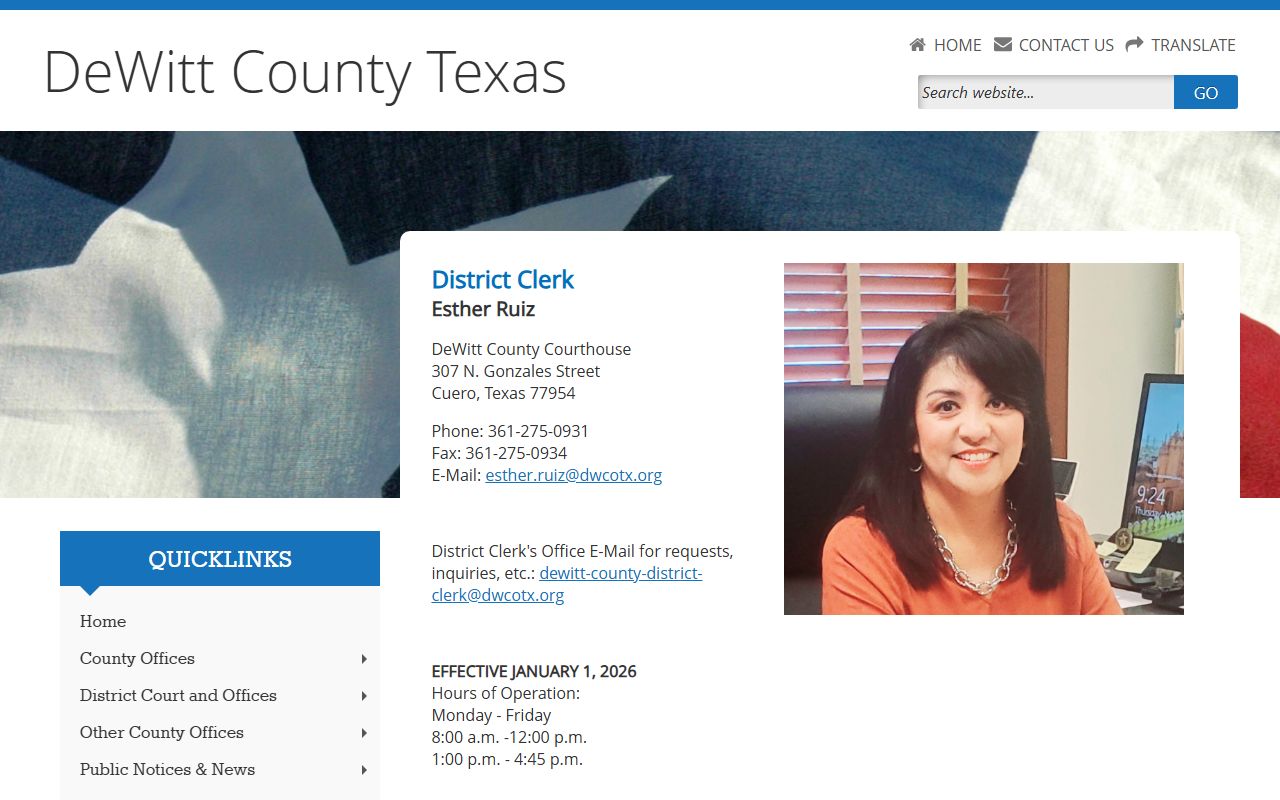
That paperless notice matters when checking newer court records after a jail arrest because the file may exist in the court software even when an online public index is limited.
DeWitt County Charging Documents
After a jail arrest, the prosecutor decides what formal charges to file. The DeWitt County District Attorney's page identifies District Attorney Brian Michael Cromeens and gives the district-level prosecutor contact at the DeWitt County Courthouse. The prosecutor is not the jail and does not operate the inmate roster. The prosecutor's filing decision is the bridge between arrest allegations and the court record.
| Document | Filed by / source | Common use |
|---|---|---|
| Complaint | Law enforcement or prosecutor sworn allegation | Often begins lower-level criminal proceedings or supports warrants. |
| Information | Prosecutor | Common formal charging document for many non-indictment cases. |
| Indictment | Grand jury | Formal felony charging document after grand jury action. |
Texas Code of Criminal Procedure Chapter 16 covers commitment or discharge after arrest, and Chapter 17 covers bail and bond. Those laws frame the post-arrest path, but the actual DeWitt County case record must be checked through the clerk or court system.
DeWitt County Charge Status
Charge status can change after arrest. A jail roster may list the booking charge used at intake, while the court record may show a different filed offense, an added count, an amended charge, or a later dismissal. This is normal in criminal case processing and is one reason court records after an arrest should be checked separately from the jail record.
| Status | What It Means |
|---|---|
| Pending | The charge has not reached final disposition. |
| Amended | The filed charge was changed by prosecutor or court action. |
| Reduced | The charge was replaced with a lower offense or lesser count. |
| Dismissed | The court or prosecutor dropped the charge. |
| Conviction | A guilty plea, verdict, or adjudication was entered. |
| Deferred adjudication | A special outcome that is not the same as a final conviction for all purposes. |
Bond After DeWitt County Arrest
Bond starts on the jail side but follows the case into court. The DeWitt jail page says to use the search feature for bonding information on a specific person and confirms that the jail can provide the bond amount. For court records after a jail arrest, the bond terms may also appear in the court file as conditions, settings, revocations, or modifications.
| Bond Type | How It Works |
|---|---|
| Cash bond | Money paid directly to secure release, subject to court rules and fees. |
| Surety bond | A licensed bondsman posts bond for a fee. |
| Personal / PR bond | Court-authorized release on promise and conditions without full cash deposit. |
| No-bond hold | The person is not releasable on that charge or hold until court or agency action. |
| Hold or detainer | Another agency may keep the person in custody after a local bond issue is addressed. |
DeWitt County Warrants and Court Dates
No official DeWitt County online warrant-search list was located in the research. The sheriff's detention page gives a direct rule: the jail will not provide warrant information, and a person must come to the Sheriff's Office in person and present valid ID to dispatch to obtain that information. Do not treat the roster as a full warrant database. It may show a warrant only after the warrant has led to a booking.
Bench warrants and failure-to-appear issues can also be tied to a specific court file. If the warrant grew from an existing case, the proper clerk may have case-index information. If the question is an upcoming court setting, use the clerk, because the jail states that it does not maintain court dockets.
Important: A possible warrant can lead to arrest. Consider legal advice before appearing at an office or court to resolve it.
Charges Versus Convictions
Being arrested and charged is not the same as being convicted. Court records after a jail arrest may show allegations long before guilt is decided. A charge can remain pending, be amended, be dismissed, result in deferred adjudication, or end in a conviction. That distinction matters for employment, licensing, housing, and public-record interpretation, although this page does not provide legal advice.
| Charge | Conviction | |
|---|---|---|
| Stage | Accusation or filed count after arrest. | Final guilt finding, plea, or adjudication. |
| Proof level | Based on probable cause or prosecutorial filing. | Based on the criminal burden required for conviction. |
| Can change | May be amended, reduced, added, or dismissed. | May be appealed, set aside, or addressed through later remedies. |
| Where checked | Jail roster for booking charge, clerk record for filed charge. | Court disposition and authorized criminal-history channels. |
Sealed and Expunged Records
Texas public-access rules start with Government Code Chapter 552, the Texas Public Information Act. Criminal-history record information is also affected by Government Code Chapter 411. If an arrest ends in a qualifying dismissal, acquittal, pardon, or other eligible event, Code of Criminal Procedure Chapter 55 may provide an expunction route.
| Sealed / Nondisclosed | Expunged | |
|---|---|---|
| Public visibility | Limited from ordinary public access. | Removed or destroyed as allowed by court order. |
| Record status | Still exists for limited authorized access. | Treated as removed for qualifying purposes. |
| Typical route | Court order limiting disclosure. | Expunction petition and court order under Texas law. |
| Best source | Clerk and court order. | Clerk, court order, and agencies listed for expunction notice. |
Note: The district clerk page references an expunction-agency-list notice, so use that office when a district-court expunction filing or record inquiry is involved.